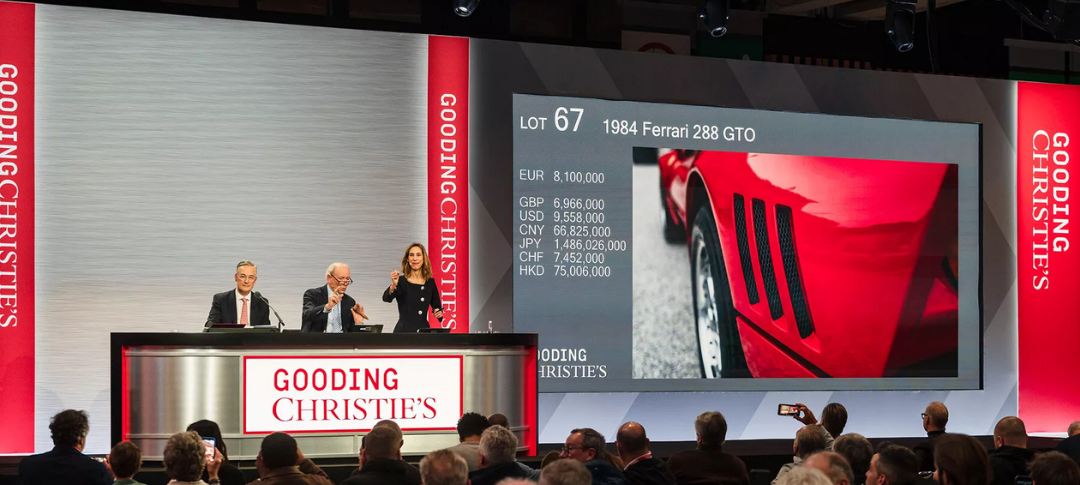
Exceptional cars and tangible assets: what role can they play in a more unstable environment?
Exceptional cars are neither an absolute safe haven nor a substitute for financial markets. They can, however, hold a relevant place within a diversified allocation, provided they are approached with discipline, cost awareness, liquidity in mind and a clear time horizon.

As volatility spreads across traditional asset classes, the role of tangible assets within a broader allocation framework is once again attracting attention. This is no longer a question for collectors alone. It also concerns investors seeking to diversify part of their capital beyond listed markets, without giving up analytical discipline.
Exceptional cars occupy a distinctive place within that discussion.
They are neither a substitute for financial assets, nor a guaranteed refuge, nor a miracle asset. They can, however, under strict conditions, constitute a differentiated patrimonial allocation: one grounded in genuine physical scarcity, shaped by cycles distinct from those of listed markets, and supported by deep cultural and generational demand.
The key, of course, lies in defining clearly what they can — and cannot — be expected to deliver.
When traditional assets stop behaving in familiar ways
One of the defining features of the current environment is the simultaneous destabilisation of several historical reference points. Equity markets remain exposed to a wide range of macroeconomic and geopolitical pressures. Bonds continue to be shaped by a more unstable rate regime. Commodities, including those traditionally viewed as defensive, have at times displayed unusually sharp price swings.
The beginning of 2026 offers a concrete illustration. Berkshire Hathaway increased its cash position to nearly $400bn, a record level, after twelve consecutive quarters of net equity sales. At the same time, gold fell in the early phase of the conflict in the Middle East, despite its conventional status as a safe-haven asset. When assets traditionally regarded as protective become more unstable themselves, the question of diversification deserves to be revisited with greater nuance.
In that context, many allocation frameworks are rediscovering a simple point: diversification does not consist solely in spreading capital across different financial instruments. It also means introducing assets that do not react to the same signals, on the same timelines, or through the same price-formation mechanisms.
It is in that sense that exceptional cars deserve to be examined.
What history teaches — and what it does not
The history of tangible assets invites nuance. It shows that in periods of monetary disorder, inflationary pressure or waning confidence in certain financial assets, scarce, desirable and difficult-to-reproduce objects can attract a growing share of capital.
The 1970s offer several useful precedents in that respect. In an environment marked by stagflation and oil shocks, certain automobiles that have since become patrimonial references began to be viewed as more than simply used cars.
The late 1980s, however, also serve as a reminder that this asset class is not immune to excess. When a market is driven by easy credit, imitation and a short-term mindset, corrections can be severe and prolonged.
The 2008 crisis, followed by several later episodes of market stress, suggests a different point: in certain highly established segments, top-tier collector cars can move on timelines distinct from those of listed markets. They do not escape macroeconomic shocks, but they do not absorb them in the same way.
That distinction matters. The right concept is not immunity. It is asynchrony.
Illiquidity as a constraint — but also as a filter
One of the most common criticisms levelled at exceptional automobiles is their illiquidity. The market is not continuously quoted. Transactions are infrequent, transaction costs are meaningful, and the value of an asset cannot be observed in real time on a screen.
All of that is true. Yet this same characteristic can also play a protective role in certain environments.
An exceptional car is not subject to algorithmic trading. It is not exposed to forced intraday selling, quantitative arbitrage or instant panic-driven moves. Its price results from a slower meeting of scarce supply and qualified demand.
This inertia should not be idealised. It does not eliminate risk. It simply changes the way risk manifests itself. Where listed markets may correct abruptly, the car market tends instead to adjust more gradually: through lower transaction volumes, longer selling periods, greater selectivity and, only then, potentially through price corrections over several quarters.
From a patrimonial perspective, that difference in behaviour can form a useful component of diversification.
Why exceptional cars can occupy a distinctive place
Not all tangible assets are created equal. Some are heavily dependent on short-lived fashion or brand effects. Others are closer to decorative objects than to patrimonial assets in any serious sense.
Exceptional cars possess several characteristics that set them apart.
They are first grounded in undeniable physical scarcity. A model produced in a few hundred examples, or a car with an exceptionally rare factory specification, cannot be recreated.
They also benefit from a dual engine of desirability: aesthetic and cultural on the one hand, technical and historical on the other. Unlike many other luxury objects, they combine use, engineering, provenance, narrative and emotional value.
Finally, demand can be sustained by powerful generational dynamics. When a cohort of buyers reaches full patrimonial capacity with a strong emotional attachment to particular references, market depth can shift in a lasting way.
None of this means that every rare car becomes a relevant patrimonial asset. It means that certain cars possess a structural foundation that few other objects can genuinely claim.
The most common mistake: confusing gross appreciation with net return
The main misunderstanding around exceptional cars often lies in how their performance is discussed.
An auction record, a sharp rise in the price of a model, or a multi-year appreciation curve still says very little about what an owner actually earns. The gap between gross value appreciation and net return can be considerable.
That gap depends on three variables.
The first is the quality of the initial selection. Buying a strong asset at the wrong price, or a mediocre asset at the price of an excellent one, weakens the result from the outset.
The second is control over holding costs: storage, insurance, preventive maintenance, documentation, remedial work, logistics and the opportunity cost of time spent immobilised during works.
The third is the exit strategy: choice of channel, timing, quality of presentation, preparation of the car, calibration of expectations and understanding of liquidity windows.
This is why market indices, useful though they may be in signalling a broader direction, capture only part of the reality. They measure an environment. They do not measure the quality of execution behind a patrimonial decision.
Signs of institutionalisation matter — without needing to be overstated
The top end of the market now shows several markers of institutionalisation: consolidation among major houses, a more international bidder base, greater professionalisation on the supply side, broader visibility of record prices, and a more explicit integration of collectible assets into the patrimonial thinking of major private fortunes.
These elements are not enough to make exceptional cars a fully institutional asset class in the financial-market sense. The market remains heterogeneous, weakly standardised and highly dependent on the quality of individual cars.
What they do confirm, however, is that this segment can no longer be analysed solely through the habits of an enthusiast market. The amounts involved, the profiles of buyers and the sophistication of the underlying arbitrage decisions have all changed in scale.
Comparative data helps frame that evolution. Knight Frank’s Luxury Investment Index 2025, based on data through Q4 2024, shows collector cars up 1.2% over twelve months, ahead of art, wine and whisky. Over ten years, $1m invested in 2005 across the basket of luxury assets tracked by the index would have grown to roughly $5.4m by the end of 2024, compared with around $5m for an equivalent investment in the S&P 500.
These comparisons should nevertheless be read as indicators of context, not as measures of net investor return. They do not account for holding costs, transaction costs or the very substantial dispersion that exists between individual cars.
What place is reasonable within an allocation?
There is no universal answer. It depends on the level of wealth involved, the required liquidity profile, the intended holding period, the depth of market knowledge and the investor’s ability to absorb the associated costs.
A general principle can nonetheless be stated: exceptional cars should be approached neither as a short-term speculative pocket nor as a yield-generating asset. Their most relevant role is as a long-duration tangible asset held within a broader patrimonial construction, selected with discipline and managed with care.
Within that framework, they can offer three qualities that are rarely found together: limited synchronisation with listed markets, value grounded in genuine physical scarcity, and a dimension of use or enjoyment absent from most other asset classes.
That promise, however, exists only on one condition: the discipline of execution must match the sophistication of the allocation thesis.
Conclusion
In a more unstable environment, exceptional cars deserve a place in patrimonial thinking — not as a simplistic substitute for traditional assets, but as a tangible allocation with its own logic.
Their patrimonial relevance lies neither in any imagined immunity nor in any autonomous promise of performance. It rests on a more demanding combination: genuine scarcity, distinct temporal behaviour, durable desirability and disciplined ownership.
The patrimonial value of this asset class can never be reduced to price trends alone. It depends on selection, holding costs, quality of stewardship and exit strategy.
Sources and references
Knight Frank — The Wealth Report 2025 / Luxury Investment Index
Berkshire Hathaway — Annual Report 2025 / Shareholder Letter
Hagerty — market data and collector car indices
Broad Arrow, Gooding Christie’s, RM Sotheby’s — public auction results, 2025–2026
Public financial and commodities sources — 2025–2026
Photo credits
Main image: RM Sotheby's
Do you have a project in this segment? We can deepen this analysis for your specific situation.
Contact us